
Louvre Abu Dhabi (Jean Nouvel)
2017, UAE
Thinking Through Alfred Gell (1945-1997)’s “Art and Agency” and “The Technology of Enchantment”
Jean Nouvel’s Louvre Abu Dhabi is not a building that frames art; it is a philosophical and phenomenological artwork—a machine for encounter. Through the lens of Gell’s theory, it becomes a distributed agent whose aesthetic agency mediates between cultures, epochs, and epistemologies.
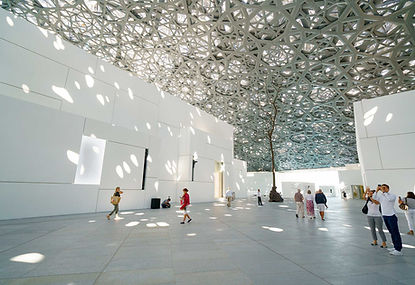
Its iconic floating dome—180 meters in diameter—performs enchantment through architectural illusion: it appears to levitate, resting on hidden supports, pierced with a complex geometric pattern of interlaced stars. Gell would interpret this as the “technology of enchantment” made manifest: the visual and mathematical intricacy overwhelms the rational eye, and the viewer becomes spellbound, suspended in the poetics of space.
This perforated dome creates a “rain of light,” as Nouvel calls it—a celestial phenomenon in architecture. As the sun moves, countless dapples of sunlight drift across the plaza and interior, suggesting the stars, the Qur’anic descriptions of light, and the play of time across human history. Gell’s notion of the index—a trace of agency—finds expression here in light itself, the nonmaterial medium that acts upon visitors. Light is not decorative but agentive, inducing moods of reverence, curiosity, and serenity.
As Gell teaches, art is relational: it mediates between people. The Louvre Abu Dhabi, too, is more than a gallery; it is a mediating interface between global civilizations. Unlike traditional national museums, it curates not through identity, but through connectivity: East and West, Islamic and Christian, classical and modern, are woven together. Gell’s “distributed personhood” applies again: the building itself becomes an intercultural subject—a person that speaks many languages, a soul of the global South hosting the world’s treasures under one dome.
Additionally, the architecture absorbs and reflects natural forces—tides, sun, humidity—emphasizing the nonhuman agencies that Gell’s later work encourages us to consider. The museum “breathes” with the sea, rising from the water like an island of reason and reflection.
Thus, the Louvre Abu Dhabi is not merely an architectural feat. It is a gesture of planetary imagination. It enacts Gell’s anthropology of art by moving beyond visuality into action, environment, and cosmopolitan ethics. It is a sanctuary of empathy in steel, stone, and light.