
Çatalhöyük Wall Murals
c. 7,000 BCE, Turkey
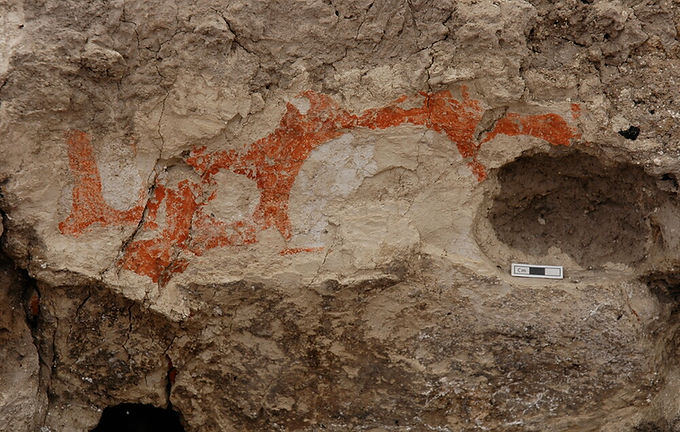
Theme: Urban life, volcanoes
Visual: Earth-tone geometric depictions, animal figures, and what may be one of the earliest maps of a city with a twin-peaked mountain (Hasan Dağ)
Thinking Through Friedrich Nietzsche (1844-1900)’s Philosophy on Art Essence
What bursts forth from the walls of Çatalhöyük is not merely symbolic representation of prehistoric life—it is the first tectonic pressure of the human will to shape chaos into cosmos. For Nietzsche, these murals offer a vital early expression of what he called the Apollonian impulse—the urge to order, to render intelligible the turbulent forces of nature and human life through stylization, through mythic geometry, through visual form. But this Apollonian construct is built directly atop a Dionysian chasm: the volcano.
Let us not be deceived by the simplicity of form. These are not merely "decorations." They are acts of world-building—of symbolic mastery over what Nietzsche in The Birth of Tragedy calls the “horrifying wisdom of Silenus,” the truth that “the best thing is not to be born, the second best is to die soon.” The volcanic eruption depicted in stark, jagged lines is the voice of Dionysus—the subterranean tremor of existence, of destruction, of eternal becoming. The city, spread out in squares beneath it, is the Apollonian response: measured, layered, structured. A polis rises to confront the fire-god of flux.
But this is no Greek idealism. It is pre-mythic, pre-Olympian, raw in its mythopoetic formation. And therein lies its power. The twin peaks, rendered like animal horns, dominate the upper half of the mural like Nietzsche’s “twin art deities”: Apollo and Dionysus. And yet their separation is not complete. They interpenetrate. The eruption is part of the map; the city is built in full knowledge of destruction. It is not a naive optimism, but a tragic affirmation—to live and build not in ignorance of annihilation, but because of it.
Nietzsche would admire this: art as courage, art as the human will saying yes in the face of death and flux. This early society of Çatalhöyük—its matriarchal shrines, its houses painted with vultures and wild bulls—shows an instinctive proximity to the Dionysian sacred. These murals were not mere records of life—they were ritual surfaces, world-making walls, where humans made contracts with the forces that would both nurture and destroy them.
From The Gay Science, Nietzsche reminds us: “We have art in order not to perish from the truth.” Here, that truth is literal: the ground will shake, the fire will rise, the gods are hungry. But the murals do not express fear. They express knowledge transmuted into rhythm, into color, into space. They affirm through stylization.
And unlike the later art of empires, the murals are not concerned with domination. They do not depict heroes or deities. They reveal a collective vision—a society’s inner world externalized not as propaganda but as ritualized affirmation of existence. The human figures are sometimes absent; it is the animal, the land, the sky, and the eruption that speak. This is the pre-individuated human spirit, not yet alienated by metaphysics or religion, still speaking in myth rather than doctrine.
Indeed, Nietzsche might say: here is art still born from instinct, not from intellect. Art that arises not to teach but to redeem life by reshaping it. Art not as comfort, but as defiance—as the will to place an image between the human soul and the indifferent universe.
In a world that later sought salvation, the people of Çatalhöyük did not ask to be saved—they painted their volcanoes, lived beneath them, and called it home.