
Albrecht Dürer – Self-Portrait
1500
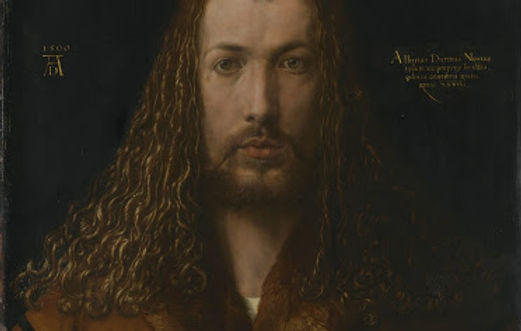
Theme: Human dignity, individuality
Visual: Dürer, age 28, presents himself frontally like Christ; long hair, symmetrical features, fur-lined robe, hand resting calmly near his heart; Latin inscription affirms his name and the year
Thinking Through Friedrich Nietzsche (1844-1900)’s Philosophy on Art Essence
In the still, frontal gaze of Dürer’s self-portrait, Nietzsche would see the death of God—and the birth of the artist as creator. For Dürer does not merely depict himself. He iconizes himself. This is not portraiture. This is apotheosis.
Dürer looks not at the world, but into us. His eyes are not introspective—they are imperial. His pose, borrowed from Byzantine Christ-icons, is deliberate. This is no accident. He assumes the posture of the divine not out of vanity, but as a revaluation of values. The divine is no longer external. It is internalized into the self.
Nietzsche, in The Gay Science, writes:
“God is dead. And we have killed him… Must we not become gods simply to appear worthy of this deed?”
Dürer, it seems, anticipated this challenge. He answers with brush and vision: Yes. I will become the image.
And yet—this painting is not loud. It is measured, exact, sober. Nietzsche would note this is not Dionysian frenzy. It is Apollonian assertion. The self is not dissolved—it is consolidated into mythic form. The symmetry is perfect. The fur-lined robe recalls the priest or king. The hand near the heart is a calm command of power.
But the true power lies in the inscription:
“I, Albrecht Dürer of Nuremberg, portrayed myself in everlasting colors at the age of twenty-eight.”
Everlasting. Nietzsche would hear the echo of eternal return: to create a self so worthy, so whole, that one would live it again and again. This is not Christian humility. It is aesthetic self-affirmation at its most defiant.
Yet it is not arrogance. It is necessity. Dürer paints not from narcissism, but from the will to form—to shape the chaos of the self into style. And that, for Nietzsche, is the highest virtue. In The Birth of Tragedy, he declared the artist the only true metaphysician—because only the artist can make illusion stronger than truth.
Here, Dürer’s illusion is the sovereign individual. And that illusion has shaped the modern world more than any doctrine.
Nietzsche would also sense irony. For behind the divine calm is a storm of anxiety—the fear of transience, the desperation to endure. This is not just self-image. It is self-rescue. And this, too, Nietzsche would understand. For the artist who dares to be his own god must battle his own abyss.
Thus, Dürer’s self-portrait becomes a moment of tragic triumph. Not in suffering, but in stillness. Not in martyrdom, but in the style of becoming.
The lines are not ornament—they are armor. The brushstrokes are not decoration—they are will made visible.
This is not the image of a man. This is the image of man as he chooses to be. And that, for Nietzsche, is the beginning of greatness.
“Who are you?” the world asks.
Dürer answers, without apology: I am my own form.