
Jean-Honoré Fragonard – The Swing
1767
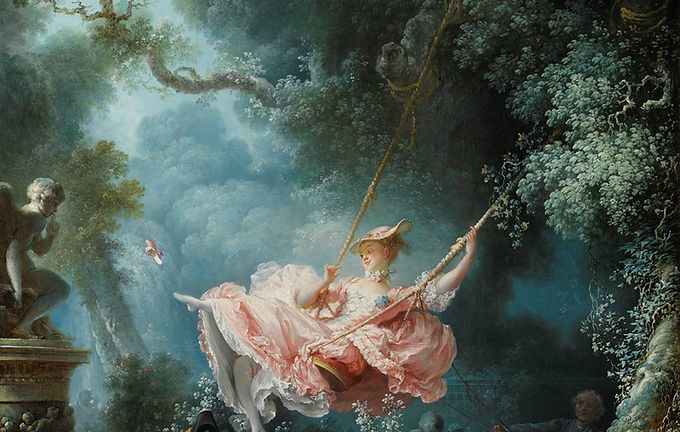
Theme: Frivolity, voyeurism, theatrical seduction
Visual: A young woman on a swing, pushed by an older man hidden in shadows; she flies upward, kicking off her shoe, revealing her legs to a young lover hidden in a bush below; statues of Cupid look on; roses bloom; light pours through pastel leaves
Thinking Through Friedrich Nietzsche (1844-1900)’s Philosophy on Art Essence
This painting is sacrilege with a smile. It is Dionysian mischief rendered in Rococo grace. Fragonard offers no moral, no lesson, no transcendence. He gives us a scene of erotic play where nothing is grounded, and that is precisely the point. The swing does not ascend toward ideals—it swoops within illusion.
Nietzsche would love this—not for its sweetness, but for its honesty. The Swing knows that existence is not noble, and instead of lamenting, it dances, it winks, it exults in the theatricality of instinct.
The young woman is not passive. She is the axis of the scene, the force of motion, the cause of desire. And yet she wears the mask of innocence—her flushed cheeks, her delicate fingers, her tossed slipper. Nietzsche would see her not as naïve, but as the artist of her own seduction. She is not ashamed. She orchestrates the gaze.
The lover below? Hiding in the bushes, staring up with delight—a voyeur turned devotee. But his gaze is not corrupt. It is an aesthetic gaze. He does not demand. He watches, receives, adores the illusion. This is the modern worshipper—not of gods, but of the well-composed moment.
The older man, shrouded in the background, pushing the swing without knowing the game—he is Socratic reason made ridiculous. Nietzsche would smile grimly: he participates, but does not understand. He is the philosopher who moves the world but sees none of its desire.
And the setting? It is not nature—it is decorated nature, an artificial paradise. The trees curve like Rococo scrolls. Light is perfumed, not divine. The roses are not wild—they are symbols of choreographed pleasure. Even the statues of Cupid look amused. They no longer command—they observe.
Nietzsche, in The Gay Science, warns against the heaviness of truth and celebrates the artist who can bear the lightness of illusion. The Swing is that celebration: lightness as metaphysical rebellion.
Here, there is no guilt. No original sin. No punishment. Only the truth that beauty, pleasure, and performance are themselves worthy of affirmation.
And yet, beneath the delight, Nietzsche would sense something more profound: the absurdity of it all. This world is unstable, floating, precarious. The swing will fall. The laughter will fade. And yet—we swing anyway.
That is Nietzsche’s tragic affirmation: to know the moment will end, and still give it your full devotion.
“Become who you are,” Nietzsche wrote.
And here, the girl does so—not through suffering, but through orchestration of joy.
She is not “the girl.” She is the actor, the creator of appearances, the stage upon which Becoming pirouettes for a fleeting, glorious moment.
This is not decadence. It is resistance to gravity—not by denying it, but by mocking it, midair, with lace and a slipper.