
Sandro Botticelli – The Birth of Venus
c. 1486
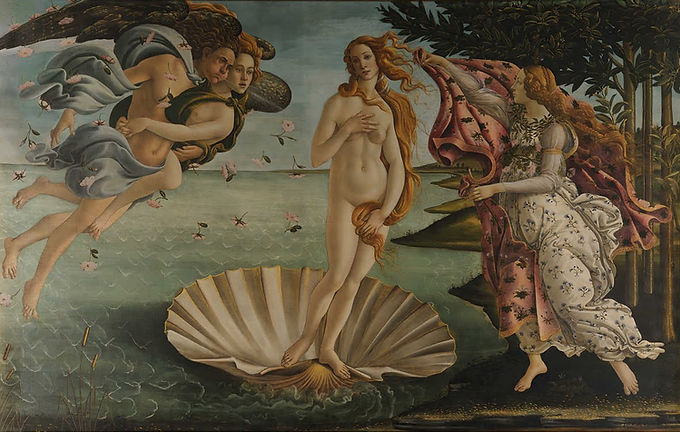
Theme: Mythology, grace
Visual: Venus stands nude on a scallop shell, blown toward shore by Zephyrus and Chloris; she is greeted by a Horae with a flower-covered robe; the sea shimmers, the air blossoms
Thinking Through Friedrich Nietzsche (1844-1900)’s Philosophy on Art Essence
Ah, Venus. She stands not in defiance, not in agony, but in serene emergence. Her body curves in classical proportion. Her skin glows. Her face—calm, detached—is not erotic, but idealized. And all around her, nature obeys. Flowers float. The wind serves. The goddess arrives not from struggle, but as a miracle of effortless birth.
Nietzsche would see in this the Apollonian will perfected—beauty rendered with such lightness and order that it hides the abyss from which it comes. Venus is a dream given form, a fiction made flesh. But what does this dream conceal?
From The Birth of Tragedy, Nietzsche teaches us that the Apollonian illusion exists to mask the Dionysian terror—the truth of chaos, suffering, and death. The Birth of Venus is one of the most seductive Apollonian dreams ever painted. It pretends to be eternal. But Nietzsche would say: No birth is bloodless.
Venus does not rise from a mortal womb. She rises from the sea—from the castration of Uranus, whose severed genitals fertilized the ocean. The myth is grotesque, primal, violent. But Botticelli purifies it. He makes the terrible palatable. This is the aesthetic instinct at full power—not to lie, but to transform the real into the bearable, into the divine.
Nietzsche would not despise this. He would recognize it as the artist’s highest gift: to create a surface of such radiant fiction that man can live with what lies beneath.
And yet, he would issue a warning. Venus, for all her beauty, is dangerous. Her power is not wisdom, not morality, but charm—the charm that seduces man into forgetting the struggle, into seeking escape in dream. She is not the affirmation of life through tragedy, but the narcotic of aesthetic comfort. A sweetness that neutralizes the will.
Look at her eyes: they do not return our gaze. They drift inward. She is there and not there, a body in stasis. She does not act—she appears. Nietzsche would ask: Is this truly the “birth” of Venus—or the death of Dionysus?
Even Zephyrus, god of the wind, is feminized, gentle. The entire world around Venus exists to support her spectacle. It is a cosmos organized around the pleasure of vision. And pleasure, Nietzsche warns, can become decadent, when it detaches from danger.
But Botticelli’s genius lies precisely here: he concentrates contradiction. The painting is beautiful, but haunted. It sings of harmony, but emerges from mutilation. It appears effortless, but is constructed with ruthless precision. It is not truth, but an antidote to truth.
And that is its greatness.
In The Gay Science, Nietzsche wrote:
“We have art so that we do not perish from the truth.”
The Birth of Venus is that art. It does not expose the truth—it offers a dream strong enough to hold it at bay. It gives man something to worship—not because it is real, but because it is sublime enough to redeem the unbearable.
So, when the Renaissance looked into the mirror of its myth, it saw not Christ, not heroism, but a goddess born of wounds, made flawless by vision.
Nietzsche would whisper:
“Yes. This too is a way to affirm life—not through laughter or strength, but through the illusion so luminous that it sanctifies Becoming itself.”