
Vincent van Gogh – Starry Night
1889
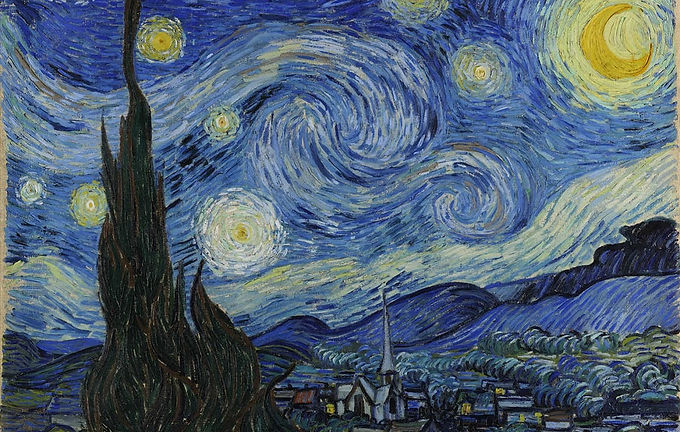
Theme: Inner vision, cosmic turmoil, madness and ecstasy
Visual: A swirling blue sky over a quiet village; massive stars blaze with halos; a flaming cypress twists upward like black fire; hills roll; a steeple pierces the center; motion permeates every inch of the canvas
Thinking Through Friedrich Nietzsche (1844-1900)’s Philosophy on Art Essence
This is not night. It is Night. Not as absence of day, but as a full ontological presence, charged, screaming, alive with Becoming. Van Gogh does not paint what he sees. He paints what sees him—what floods through his nerves, his agony, his will.
Nietzsche would not call this madness. He would call it truth without the filter of “reason”. Starry Night is what happens when Dionysus rips through the veil of appearances, when the world is not calm, not measured, but violent with vitality.
The stars—so often symbols of distance, logic, the fixed heavens—here become organic, monstrous, divine again. They whirl. They spin. They pull at the viewer like myth reborn in fever.
Nietzsche would see this sky as a counter-move to nihilism: Yes, God is dead. Yes, meaning collapses. But look—still, the world burns with vision. And Van Gogh, the suffering seer, does not retreat. He gives us this light—not in comfort, but in defiance.
The cypress—dark, flame-like—rises like Dionysus himself, joining earth to sky, passion to infinity. It does not bloom. It twists. It is not hope. It is will, affirmation through form, the ugly made sublime.
The village below sleeps. It is still. Peaceful. But it is not the subject. Nietzsche would note the contradiction: the town, with its little steeple, symbolizes order, morality, structure—but it is small, contained, irrelevant in the face of the writhing heavens.
Van Gogh turns the traditional hierarchy upside-down. The sky is no longer background—it is protagonist. It breathes, it moves, it wills. This is the world as felt by the soul on fire.
In The Birth of Tragedy, Nietzsche writes:
“It is only as an aesthetic phenomenon that existence and the world are eternally justified.”
This painting is the rawest form of that principle. Van Gogh does not justify through harmony or clarity. He justifies through intensity, through the courage to feel fully and transmute that feeling into style.
And style—here—is not polish. It is vibration, stroke, motion that never resolves.
Nietzsche would call this painting a hymn to subjectivity. A world no longer dictated by external gods, but shaped by the inner pulse of the artist’s own becoming.
Van Gogh is not illustrating nature. He is wrestling with it. And in that wrestle—like Jacob with the angel—he emerges wounded, yes, but aflame with the vision of what art can still do: not lie, not comfort, but ignite.
“To live is to suffer,” Nietzsche would say.
“To survive is to find some meaning in the suffering. But to transmute that suffering into vision—that is what makes one a creator.”
Starry Night is not madness. It is genius refusing silence. The cosmos, indifferent, becomes a mirror of the soul that dares to look back.