
Trace (Alcatraz) by Ai Weiwei
c. 2014 CE – Contemporary, China
Thinking Through Martin Heidegger (1889-1976)’s “The Origin of the Work of Art”
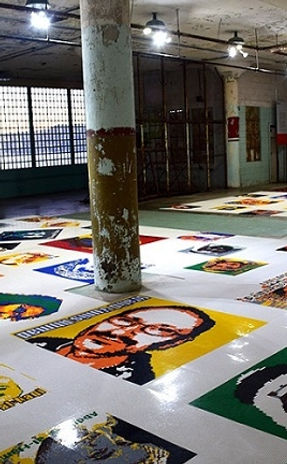
Ai Weiwei’s Trace—an installation composed of thousands of LEGO portraits of political prisoners—resides at the intersection of material triviality and existential gravity.
Heidegger would not dismiss this as mere political art. Rather, he would see it as a world-disclosive event, where truth about modern Being-with-others is unconcealed through fragmentation and pattern.
The medium—plastic bricks—suggests impermanence, play, and industrial standardization. Yet from this banal earth, Ai constructs faces that demand recognition. Heidegger would recognize here a transformation of earth’s resistance (here: impersonal material) into a world of individual presence. These are not likenesses; they are events of acknowledgment.
The world that arises is fractured: totalitarian suppression, global surveillance, civil courage. The earth is anonymous, repetitive, manufactured. But precisely in this tension, Being happens—in the form of the forgotten made visible, the silenced re-voiced. The LEGO face is not a portrait—it is a clearing where the human reappears under erasure.
In Heidegger’s terms, Trace reveals how art in the technological age does not beautify but preserves unconcealment by exposing what is concealed under systems. It does not idealize the prisoner—it lets their Being insist, pixelated but irreducible.