
Sumer Is Icumen In
c. 1250, England
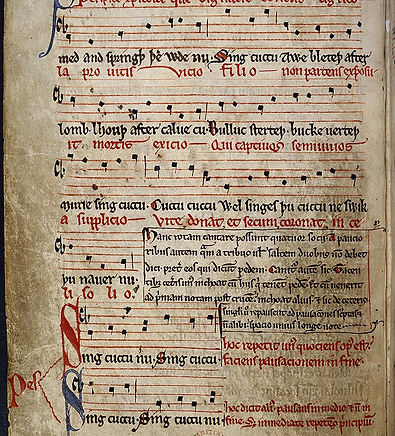
Theme: Fertility, Nature, Musical Circularity
Thinking Through Friedrich Nietzsche (1844-1900)’s Philosophy on Art Essence
“Sumer is icumen in, lhude sing cuccu!”—so begins one of the oldest surviving canons in Western music, bursting forth in Middle English like the song of a people unburdened by sin, dancing not toward salvation but within the bloom of the earth itself. For Nietzsche, this would not be a quaint folk relic; it would be a rare expression of Apollonian clarity celebrating Dionysian fecundity—a union of form and force, of pleasure and order.
This canon is pagan in spirit, even if birthed within a Christianized Europe. It praises not saints or angels, but cuckoos, ewes, the greening fields, and flowing seed. Here is not the penitential tone of medieval liturgy, but a musical laughing birth cry—one that affirms not the next world, but this one. Nietzsche, who lamented Christianity’s negation of the body and nature, would hear in this round an echo of the ancient tragic chorus, where men sang not to escape mortality, but to celebrate life’s pulsing recurrence.
In The Birth of Tragedy, he identifies the Apollonian as the domain of order, dream, and form—and the Dionysian as the domain of intoxication, instinct, and ecstatic fusion with nature. “Sumer Is Icumen In” is a perfect synthesis of these two drives. The canon form, with its strict polyphonic structure, its mirroring and overlapping voices, is quintessentially Apollonian—mathematically ordered joy. But what it celebrates—fertility, nature, rutting animals, the cyclical return of warmth and pleasure—is pure Dionysus.
Nietzsche would say: this music knows the eternal return.
Indeed, “Sumer Is Icumen In” is structured as a round, a musical loop that seems to echo endlessly, like the seasons, like the mythic wheel of time. Each part enters and overlaps with the next, and the result is not hierarchy, but harmonic interweaving—a metaphor, perhaps, for Nietzsche’s own critique of linear, teleological thinking. Here is no ascent toward divine perfection. Here is circularity, joy without purpose, affirmation without end.
“Remain true to the earth,” Nietzsche urges in Thus Spoke Zarathustra. And here, the music does just that.
The cuckoo’s call becomes a refrain, not unlike the primal cry of satyrs in Dionysian festivals. Ewe bleats, seed sows, grass grows. This is life as celebration, not sermon. The canon’s repetition is not wearying but ecstatic—like the dance that spirals ever faster around the maypole, drawing man into unity with his animal and vegetal brethren. In Nietzsche’s terms, this is art that intoxicates without mystification.
Importantly, though composed anonymously in a monastic context, the music betrays little of Christian guilt or restraint. Its lyrics are earthy. Its harmonies, bright. Its tone, resolutely this-worldly. Nietzsche would likely declare: here is the unconscious song of a Europe still close to its pre-Christian roots, still singing with the voice of the body before it was shamed, still delighting in Becoming without needing justification from Being.
Where Christian music often builds toward transcendence, “Sumer Is Icumen In” spirals into presence.
“Every day should be a festival of the senses,” Nietzsche wrote indirectly in his aesthetic philosophy. This song does just that—with no theology, no moral, no meaning—only the rhythmic Yes of springtime.
In its rustic exuberance and technical brilliance, this canon is not an artifact of innocence but of unrefined wisdom—the kind that knows suffering exists, but chooses to sing the cuckoo’s cry anyway, in harmony with the fecund earth.